


Citizenship Project : Students & Housing Campaign
- EPAS at USP College (Editorial Board)

- Mar 25
- 9 min read

As part of USP College's EPAS spring term program, the EPAS groups in Seevic and Palmer's campus ran a variety of citizenship projects. This Seevic-based group focused on the issue of housing and what students think about housing solutions. This included the following EPAS ambassadors: Ana Sahajahan, Hollie Perry, Lilly Nunn, Macy Rimmell, Niamh Thurston, Rose Sparks and Sebastian Rapley Mende.
Report:
The main aim for our citizenship project was to spread awareness on the topic of housing and how young people today face a variety of issues with housing affordability. Throughout this project we were trying to understand how much information individuals know about the different types of housing available and affordability whilst also incorporating their feelings on the current state of the housing market.
As a group, we chose the topic of youth housing because we believed that housing is a national concern that is often overlooked, and we believed there was little awareness of how big of a problem it is becoming. Housing costs have risen significantly over recent years and are continuing to increase, making it harder for young people to rent or buy homes. The housing market also has made it difficult to rent and then move on to purchasing a house due to the disparity between average wages and average house prices. Researching the issue of youth housing also allowed us to explore how economic factors, government policies and social inequality impacts the opportunities available to young people. We decided that we would look at student's views from across the college and find out if there was a real concern about housing in their area.
We created an online survey containing questions which would help us gain an insight into statistics and opinions within the issue youth housing (see: 'Survey Results & Analysis' section, below). To promote our survey, we created posters and leaflets to display around USP college in order to improve engagement and ensure a wide range of results. This was done to make sure the survey represented as many views as possible. After receiving the results, we were able to evaluate them which allowed us to form a better understanding of USP student's / young people’s concerns and wants regarding the topic of housing.
When conducting our youth housing survey for the Citizenship Project, we met and overcame several obstacles to successfully retrieve the results we needed. Whilst collecting our data we had to combine our creative thinking skills and communication with our peers to get our aims across to young people at USP College. Another challenge we faced was engagement from students. To overcome this, members created appealing posters with access to our survey and promoted this around the campus as well as approaching students to encourage their participation. Small posters were displayed on tables throughout the college, from the canteen to the library, which allowed us to reach a broader range of students at the college.

Our EPAS group overcame this challenge as evidenced by the 41 students who engaged with the survey and communicated their feelings on housing. On average, each respondent spent 2 minutes and 56 seconds on the survey, demonstrating that students were taking the survey seriously, giving well thought out responses. Another challenge was creating direct and clear questions that students felt were answerable. This issue was overcome by making 14 out of the 15 questions multiple choice, with an optional written question at the end allowing students to specifically put down any thoughts they had. To make sure the survey was accessible, we created a QR code and trialed it several times before releasing it to the students on campus to ensure that everyone could access it without difficulty.
When constructing the survey, the group discussed potential questions for the survey to make sure the survey would retrieve the data needed but was also understandable to anyone – regardless of prior knowledge about housing issues - and suitable to their demographic, this being young people aged 16-18.
Survey Results & Analysis:
Section 1
The first of the three sections of the survey focused on current housing for students.


Question 1 asked about home ownership. 46% of respondents said they lived in a privately owned home. The privately rented category received 20%, socially rented received 17% and not sure received 15%. What this shows is that the vast majority of respondents know what kind of housing they live in, with roughly half living in rented properties and the other half living in owned properties.
Question 2 covered the style of accommodation, with the vast majority (80%) of respondents saying they lived in houses. Bungalows accounted for 10% of respondents, with all other types of accommodation accounting for 10% of respondents.
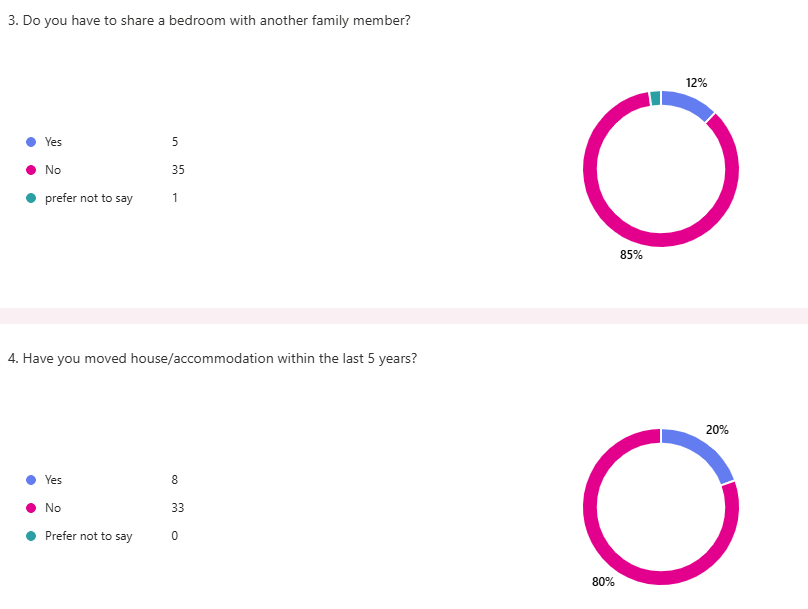
Question 3 asked whether respondents had to share a bedroom with another family member. 85% of respondents said they did not have to share, with 12% saying they did share a bedroom.
Question 4 asked if respondents had moved within the last 5 years. 80% said they had not moved, with 20% saying they had.
Question 5 asked respondents to assess how accessible various amenities (such as schools or shops) were from where they live. A rating of 1 meant that these amenities were very inaccessible, with a rating of 5 meaning that amenities are very accessible. In the results, 90% of respondents said that amenities were either accessible or extremely accessible, with only 2% of respondents saying that amenities were inaccessible.
This section demonstrated that generally students lived in privately-owned homes, with good access to local services, whilst not having to share rooms.
Section 2
The second section of the survey focused on what students know about housing in their local area in Castle Point. In each question, only one of the answers provided was correct, allowing us to see what young people believe the housing market looks like.


Question 6 asked how many times greater the average house price is compared to average income in Castle Point. The correct answer was 9.3x, which only 7% of respondents got correct. Of the remaining respondents, 17% guessed higher than 9.3x, whilst 76% guessed below 9.3x. This shows that students underestimate the disparity between incomes and property prices in their local area.
Question 7 asked how much people pay as a proportion of income, on average, for (private) rent in Castle Point. The correct answer was 29% which only 5% of respondents got right. The other 95% guessed above this, selecting the 35% and 44% categories. This showed that unlike Question 6, students overestimated the amount people pay in rent.
Question 8 asked what the average house price for first-time buyers was in Castle Point. The correct amount was £321,000. The largest category selected was £321,000 which received 49% of responses. The second highest category was £289,000 with 37% of responses. In total, 41% of responses were below the correct answer, with 10% of responses above the correct answer.
Except for house prices, students generally did not know the correct answers for this section. What this demonstrated was that students underestimated the cost of housing in Castle Point, showing there is a lack of information to do with affordability in schools.
Section 3
The third section asked students about political decisions to do with housing.


Question 9 asked about whether students knew any housing policies put forward by government or political parties. The vast majority (73%) of responses answered ‘No, not really’ or ‘No, don’t know anything on this topic’ for this answer, with only 15% of responses being either ‘Yes’ or ‘Yes, somewhat’. This showed that housing policy is not talked about enough, considering most students seemingly knew nothing or very little about it.
Question 10 asked students if they were worried about housing affordability in the future. 80% of responses answered with either ‘Yes, somewhat’ or ‘Yes, definitely’, with ‘Yes, definitely’ being larger (46%) than ‘Yes, somewhat’ (34%). Of the remaining 20%, 10% answered ‘Maybe / Not Sure’ and 10% answered 'No, not really’ and ‘No, not at all’. This showed that the vast majority of respondents were worried about housing affordability, which is a view that is held across the UK by young people.
Question 11 asked students whether more social housing should be built. The largest category was ‘Yes, but not a priority’ with 34% of responses. 29% of responses were for both ‘Yes, absolutely’ and ‘Maybe / Not Sure’. This meant that 64% of respondents said that more social housing should be built, with only 7% saying that more social housing should not be built.
Question 12 asked whether students wanted more houses or flats built. 76% of students answered ‘Houses’ with 20% preferring flats and 5% answering ‘Other’. This result was very similar to Question 2, where 80% of students lived in houses. This shows students would prefer to continue living in houses rather than move to some other kind of accommodation.
Question 13 asked whether housing should be a major priority for government. The largest category was ‘Yes, but not as the main priority’ with 44%. Both of the categories ‘Yes, absolutely’ and ‘Maybe / Not Sure’ both accounted for 24% of responses. Only 7% of responses said that housing should not be a priority for government. This demonstrated that, similar Question 11, students wanted housing to be a priority for government, but not as the main priority to government.
Question 14 asked whether students would become politically active if housing became a major political issue in the UK. The largest category was ‘Maybe / Not Sure’ with 39% of responses, with ‘Yes’ having 32% and ‘No’ having 29%. This showed that similar to previous questions a large minority of young people were more politically active and wanted serious change in housing policy, with most people being more unsure.
Question 15 was an open question, where students could type any other thoughts they had. Most responses were some variants of ‘N/A’, however there was one longer response focused on affordability and uncertainty in the new future. They said: “Most of the issues [to do with housing] all stem from uncertainty and fear which is being taken out in the wrong places.”
For this section, it was clear that young people viewed housing as a serious issue, and that more housing should be built by government. However, only a minority said that housing should be a main priority for government, with the rest viewing it as important but not a priority. This showed that whilst housing was an issue for young people, there were many other issues which young people were also concerned about, meaning that young people were less likely to prioritise housing over other issues.
Overall, from the results it can be said that young people are generally worried about the affordability of housing, but do not know of any efforts to alleviate it or any movements / campaigns to change housing policy. In addition, the wide variety of issues facing young people (such as cost of living, tuition fees) means that housing as an issue has been deprioritised. This shows that more needs to be done in terms of outreach by campaigns and education, to get more young people involved with housing issues and solutions.
Reflection on the Survey / Project:
In total, 41 students participated in the survey out of roughly 2500 students in the college, which translated to a turnout of 1.64%. This low turnout was in spite of the easy access to the QR code, which were displayed on posters throughout the college. The data was displayed in pie charts and bar graphs to make data analysis easier as well as to make it easily accessible to people reading the report. The validity of the survey was potentially weak however, as the low turnout meant that the views of students from the survey were only for a very small group of young people. It was more likely that the low turnout was due to a lack of interest, as the use of simple multiple choice questions and posters displayed throughout the college meant that accessibility was not an issue for the survey. This potentially showed instead that young people at USP College did not have much interest or knowledge on housing and did not think housing was a significant issue.
During the citizenship project, we developed skills including teamwork, decision-making skills, and evaluative skills. First, we had to work as a team, and in our group we had to discuss different ideas we each had for the project, whilst also communicating our opinions and preferences for our ideas for our assignments and how to execute them fairly. In this process, we had to make decisions on what topics we should cover, whilst accommodating different ideas. We each carried out research on housing in Essex which led to conversations on what information we wanted to include in the survey and posters. We then decided to split up the workload by assigning tasks to each member of the group, allowing us to carry out the project more efficiently. This included the report on the citizenship project, with each individual writing about a separate part of the project.
Looking forward, we would like to continue our work on awareness surrounding housing issues within the college. As was shown in the survey results, many young people were concerned about housing issues but knew very little about it. This could be done with a future education campaign to do with housing, perhaps working with a local housing campaign group or charity to help spread awareness.
In conclusion, this citizenship project has highlighted two key issues. First, there was a need for better awareness on housing issues for those who did not know or were not interested from the survey. Secondly, for those who were concerned, it was clear that they did not know much to do with housing policy or campaigns to improve policy. By running future projects alongside campaign groups, we hope to promote active citizenship on the issue of housing and increase the importance of housing for young people.


Comments